
1. Ro-ràdh
Welcome to the instruction manual for your Amewi Binary V3 RC Sailboat. This attractive and elegant catamaran is designed for ease of sailing and is now in its third generation, featuring new technical advancements. It includes automatic sail correction for gusts and intelligent control to significantly reduce the risk of capsizing. Whether you are sailing in a large swimming pool, pond, or lake, the Binary V3 promises an enjoyable experience. Its rich sailing characteristics are supported by high-quality materials and design, making it suitable for both beginners and experienced enthusiasts.
This manual provides essential information for the safe and effective operation, maintenance, and troubleshooting of your RC sailboat. Please read it thoroughly before first use.
2. Stiùireadh Sàbhailteachd
Operating remote-controlled models requires caution and responsibility. Failure to operate the model safely can result in injury or damage to property. Always adhere to the following safety guidelines:
- Cuingealachadh Aois: This product is not suitable for children under 3 years due to small parts which may present a choking hazard. Recommended age is 14 years and above.
- Stiùiridh: Children operating the model must be supervised by an adult.
- Sàbhailteachd uisge: Operate the sailboat only in open water areas, away from swimmers, boats, and obstacles. Avoid operating in strong currents or high winds that exceed the model's capabilities.
- Sàbhailteachd bataraidh: Always use the correct type and size of batteries. Do not mix old and new batteries, or different types of batteries. Dispose of used batteries responsibly. Never short-circuit battery terminals.
- Suidheachaidhean Àrainneachdail: Do not operate the model during thunderstorms or in adverse weather conditions.
- Cumail suas: Regularly inspect the model for any damage or wear. Do not operate a damaged model.
3. Pasgan-susbaint
Mus cuir thu ri chèile e, dèan cinnteach gu bheil na pàirtean uile a tha air an liostadh gu h-ìosal an làthair sa phacaid agad:
- Amewi Binary V3 RC Sailboat Model (Hulls, Mast, Booms, Sails)
- 2.4 GHz Digital Proportional Remote Control Transmitter
- Seas bàta
- Instruction Manual (DE/EN)
Rudan a dh’ fheumar (Gun a bhith air an gabhail a-steach):
- 4 x 1.5V AA Mignon batteries for the model (receiver)
- 4 x 1.5V AA Mignon batteries for the transmitter

Dealbh 1: Thairisview of the Amewi Binary V3 RC Sailboat package contents, showing the disassembled boat, remote control, and boat stand.
4. Suidheachadh agus Seanadh
The Amewi Binary V3 is designed for quick and easy assembly. Follow these steps to prepare your sailboat for its first voyage:
4.1. Install the Boat Stand
Assemble the plastic boat stand according to the diagrams in the included manual. This stand will support the boat during assembly and storage.
4.2. Stàladh bataraidh
- Transmitter: Open the battery compartment on the back of the 2.4 GHz remote control. Insert 4 x 1.5V AA Mignon batteries, ensuring correct polarity. Close the compartment.
- Boat (Receiver): Locate the battery compartment within the boat's hull. Insert 4 x 1.5V AA Mignon batteries, observing correct polarity. Securely close the compartment to prevent water ingress. It is recommended to use gaffer tape or similar waterproof sealing after the first few uses to ensure the electronics remain sealed, as the factory patches may require reinforcement.

Image 2: The J2C02 remote control transmitter and its corresponding receiver unit, which are essential for controlling the sailboat.
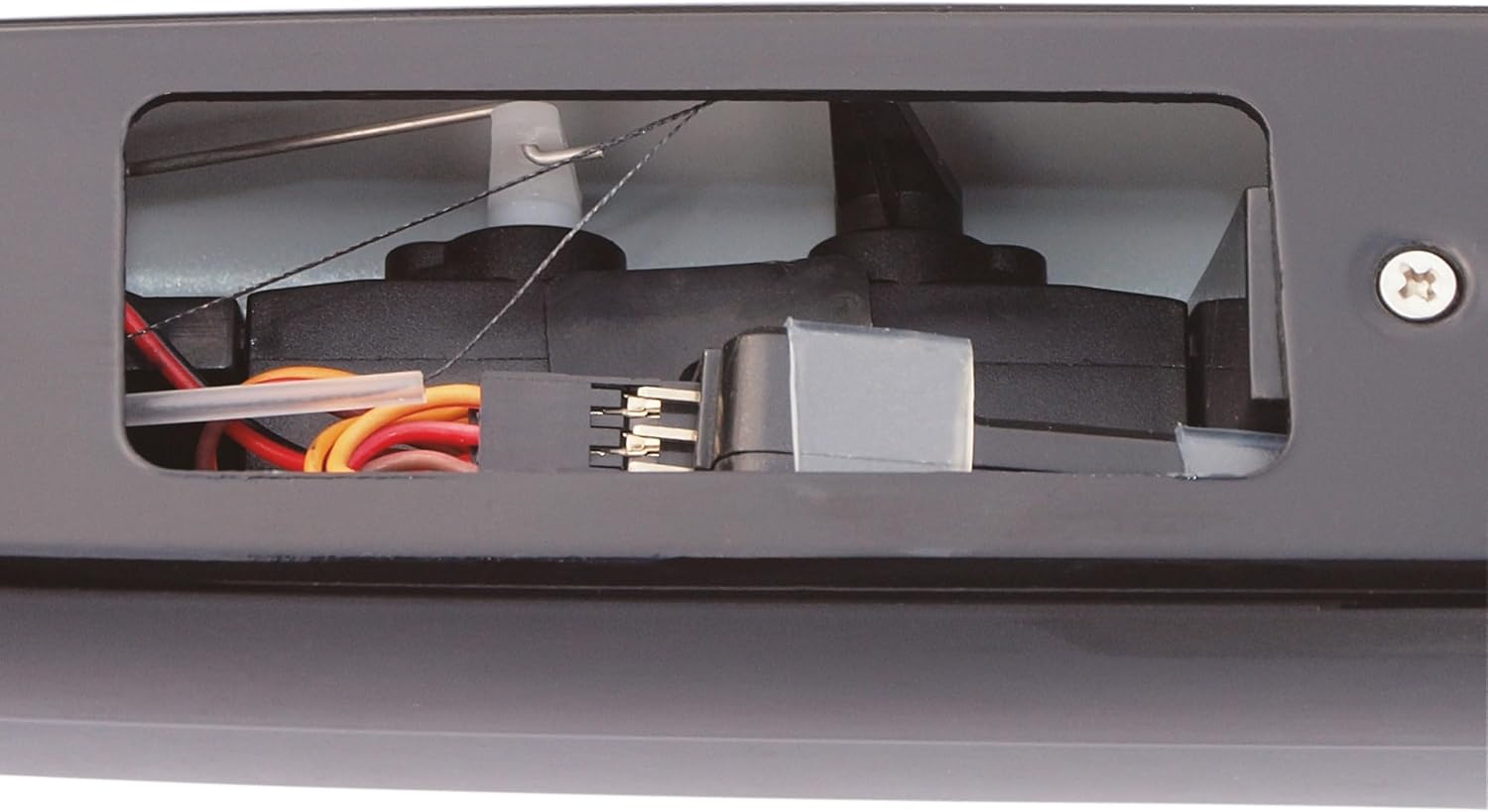
Ìomhaigh 3: Sealladh dlùth view of the internal electronics compartment of the sailboat, showing the receiver and servo connections.
4.3. Mast and Sail Assembly
The mast and boom are constructed from durable fiberglass. Follow the instructions carefully for proper rigging:
- Attach the mast to the main hull.
- Connect the main sail and jib sail to their respective booms and then to the mast. Ensure all lines are securely fastened.
- Sail Line Rigging: The included manual may provide general guidance for sail line routing. However, for optimal performance and to avoid issues, it is recommended to consult online resources or diagrams for proper RC sailboat sail rigging techniques if the provided instructions are unclear or lead to poor performance. Correct rigging ensures the sails can be adjusted effectively by the servos.
4.4. A’ ceangal an tar-chuir agus an glacadair
The transmitter and receiver are typically pre-bound from the factory. If you experience connection issues, follow these steps to re-bind:
- Ensure both the transmitter and receiver have fresh batteries and are powered off.
- Tionndaidh air an inneal-sgaoilidh.
- Power on the boat (receiver). Look for a binding button or sequence as described in the detailed manual.
- The indicator light on the receiver should become solid, indicating a successful bind. If issues persist, try powering on the boat first, then the transmitter, or vice-versa, as some units can be sensitive to the power-on sequence.

Image 4: The fully assembled Amewi Binary V3 RC Sailboat resting on its included stand, showcasing its catamaran design and sails.
5. Stiùireadh Obrachaidh
Once assembled and powered, your Amewi Binary V3 RC Sailboat is ready for operation. Familiarize yourself with the controls and sailing principles.
5.1. Smachdan Bunasach
The 2.4 GHz proportional remote control allows precise manipulation of the sailboat:
- Steering (Rudder): Typically controlled by one joystick or wheel on the transmitter. This adjusts the rudder to change the boat's direction.
- Sail Control: Controlled by another joystick or lever. This adjusts the angle of the sails relative to the wind, allowing you to harness wind power for propulsion.
- Trims: Small buttons or sliders near the joysticks allow fine-tuning of the rudder and sail positions to ensure the boat sails straight or maintains a desired sail angle without constant input.
5.2. Sailing Tips
- Wind Awareness: Always be aware of the wind direction and strength. RC sailboats are highly dependent on wind.
- Atharrachadh Seòl: Adjust your sails to the wind. When sailing directly into the wind (no-go zone), the boat will stop. You will need to tack (turn through the wind) or jibe (turn away from the wind) to change direction.
- A' tionndadh: Use the rudder for steering and coordinate with sail adjustments for smooth turns.
- Smart Control Features: The Binary V3 features automatic sail correction in gusts and intelligent control to reduce capsizing risk. These systems work automatically to maintain stability and optimal sailing performance.

Image 5: The Amewi Binary V3 RC Sailboat actively sailing on water, demonstrating its performance and stability.
6. Cumail suas
Proper maintenance will extend the lifespan of your Amewi Binary V3 RC Sailboat and ensure consistent performance.
- Às deidh gach cleachdadh:
- Remove the batteries from both the boat and the transmitter.
- Thoroughly dry the boat, especially the electronics compartment, to prevent corrosion.
- Clean the hull and sails with fresh water to remove any salt, dirt, or debris.
- Cùram Bataraidh: Store batteries in a cool, dry place. Do not leave batteries in the model or transmitter for extended periods when not in use.
- Sail and Rigging Inspection: Regularly check the sails for tears or damage. Inspect all lines and connections for wear or looseness. Replace any damaged components.
- Hull Integrity: Periodically check the hull for cracks or leaks. Ensure the seals for the electronics compartment are intact. As noted in user feedback, reinforcing the seals with waterproof tape (e.g., gaffer tape) after initial uses can significantly improve water resistance.
- Stòradh: Store the sailboat on its stand in a dry, cool place away from direct sunlight.
7. A ’dèanamh trioblaid
If you encounter issues with your Amewi Binary V3, refer to the following common problems and solutions:
| Trioblaid | Adhbhar a dh’fhaodadh a bhith ann | Fuasgladh |
|---|---|---|
| Chan eil am bàta a’ freagairt an tar-chuir. | Low batteries in boat or transmitter; Transmitter and receiver not bound; Power-on sequence issue. | Replace all batteries with fresh ones. Re-bind the transmitter and receiver (refer to Section 4.4). Try different power-on sequences (e.g., transmitter first, then boat, or vice-versa). |
| Sails do not move or move incorrectly. | Sail lines tangled or improperly rigged; Servo malfunction; Low batteries. | Check sail lines for tangles and ensure correct rigging (refer to Section 4.3). Check battery levels. If servo is faulty, contact support. |
| Boat is unstable or capsizes easily. | Strong wind conditions; Improper sail trim; Damaged hull or keel. | Operate in calmer conditions. Adjust sail trim using the transmitter. Inspect hull and keel for damage. The V3's intelligent control should mitigate this, but extreme conditions can still be challenging. |
| Water inside the electronics compartment. | Improperly sealed compartment; Damaged hull. | Ensure the compartment lid is securely closed. Apply waterproof tape (gaffer tape) around the seal for added protection. Inspect the hull for cracks and repair if necessary. Immediately dry out electronics if water ingress occurs. |
8. Sònrachaidhean
Technical details for the Amewi Binary V3 RC Sailboat:
| Feart | Sònrachadh |
|---|---|
| Modail | 26107 Binary V3 |
| Fad | 400 mm |
| Leud | 255 mm |
| Àirde a' Chrainn | 565 mm |
| Àirde iomlan | 710 mm |
| Cuideam | 360 g |
| Jib Sail Area | 2.6dm² |
| Main Sail Area | 5.3dm² |
| Total Sail Area | 7.9dm² |
| Stuth Hull | Plastaig ABS àrd-neart |
| Mast & Boom Material | Fibreglas |
| Seirbhisich | 2 x 9g (pre-installed) |
| Smachd Iomallach | 2.4 GHz Proportional 2-Channel Digital |
| Stòr cumhachd | Bataraidh air obrachadh |
| Required Batteries (Model) | 4 x 1.5V AA Mignon |
| Required Batteries (Transmitter) | 4 x 1.5V AA Mignon |
9. Barantas agus Taic
For warranty information and customer support, please refer to the documentation included with your product or visit the official Amewi weblàrach. Cùm dearbhadh ceannach airson tagraidhean barantais sam bith.
Oifigeil Weblàrach: amewi.com