
1. Ro-ràdh
The HQST 20A PWM Flush Mount Solar Charge Controller is designed to efficiently manage power flow from your solar panels to your battery bank, ensuring optimal charging and protection. It is compatible with both 12V and 24V battery systems, supporting various battery types including Lithium, Sealed (AGM), Gel, and Flooded batteries. This manual provides essential information for proper installation, operation, and maintenance of your solar charge controller.
2. Toradh thallview
Familiarize yourself with the components of your HQST solar charge controller:
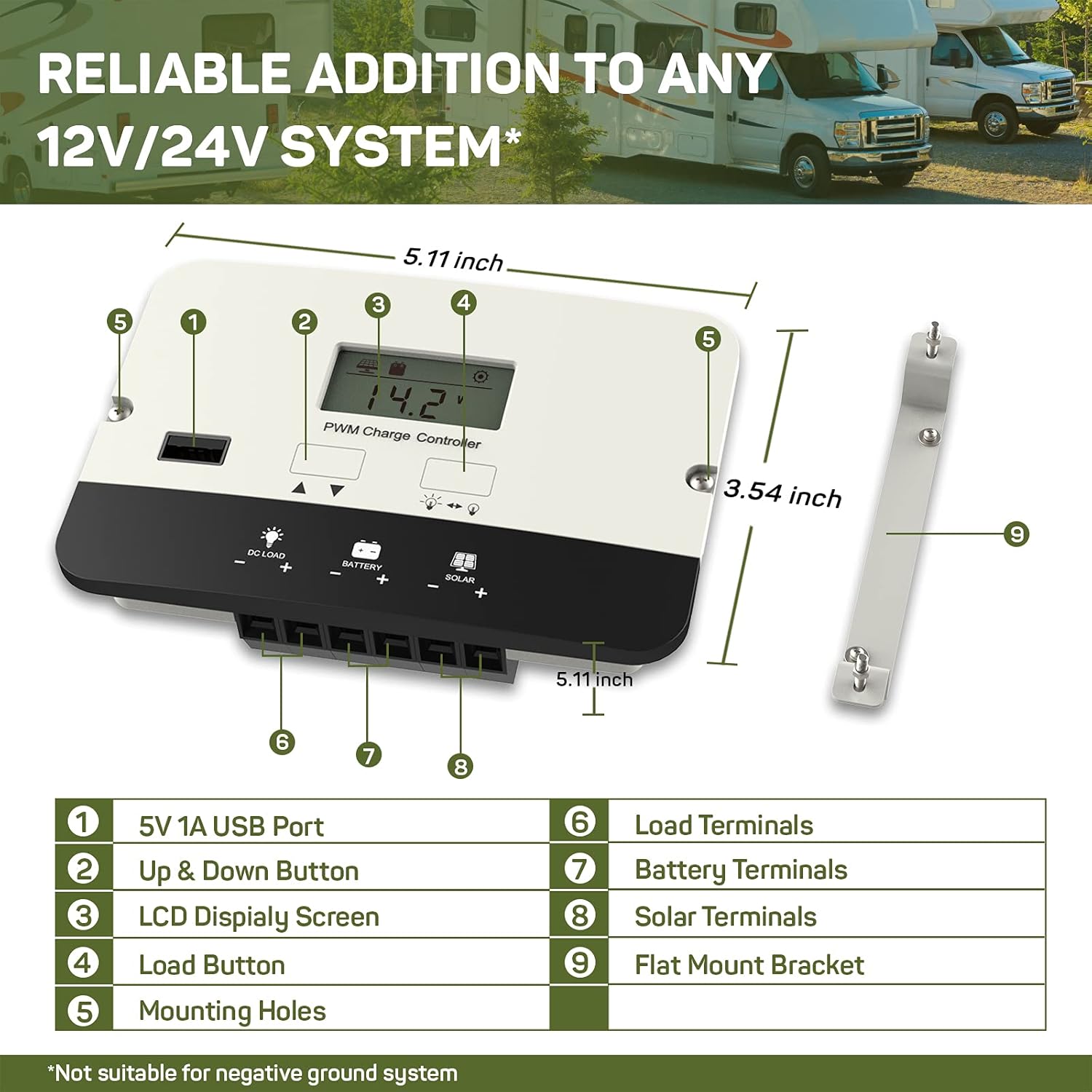
This diagram illustrates the key components and dimensions of the HQST 20A PWM Flush Mount Solar Charge Controller. It measures approximately 5.11 inches in length and 3.54 inches in width.
- 5V 1A USB Port: Airson innealan co-chòrdail ri USB a ghearradh.
- Putan Suas is sìos: Used for navigating display screens and adjusting settings.
- Sgrion taisbeanaidh LCD: Shows real-time system data and settings.
- Putan Luchdaich: Controls the DC load output.
- Tuill-taic: For securing the controller during installation.
- Load Terminals: Connect to your DC loads.
- Crìochnachaidhean Bataraidh: Ceangail ris a’ bhanca bataraidh agad.
- Solar Terminals: Ceangail ris an raon pannalan grèine agad.
- Flat Mount Bracket: Optional bracket for surface mounting.
3. Suidhich
3.1 Stàlaich an rianadair
The controller offers flexible mounting options:

The controller can be installed using either a flush mount for a seamless look or a flat mount with the provided bracket. Choose a location that is dry, well-ventilated, and away from direct sunlight or heat sources.
- Sliabh Fliuch: Integrate the controller directly into a panel or wall for a clean finish.
- Mullach còmhnard: Use the included bracket to mount the controller on a surface.
Ensure adequate space around the controller for air circulation to prevent overheating.
3.2 Ceanglaichean Uèiridh
Follow the correct wiring sequence to prevent damage to the controller or battery:
- Ceangail am bataraidh: First, connect the battery to the controller's battery terminals (7). Ensure correct polarity (positive to positive, negative to negative). The LCD will power on.
- Ceangail am Pannal Solar: Next, connect the solar panel to the controller's solar terminals (8). Ensure correct polarity.
- Ceangail an Luchd DC: Finally, connect your DC loads to the controller's load terminals (6). Ensure correct polarity.
Disconnection Sequence: To disconnect the system, reverse the order: disconnect the load, then the solar panel, and finally the battery.

This wiring diagram illustrates the proper connection order for the solar panel, battery, and DC load to the HQST solar charge controller.

When connecting wires, ensure they are inserted into the correct square socket for the cable, not the screw hole. Fully unscrew the terminal screws, insert the wire ends, then tighten the screws securely.
3.3 Suidheachadh Seòrsa Bataraidh
The controller automatically recognizes 12V/24V Sealed (AGM), Gel, and Flooded batteries. For Lithium batteries, manual parameter setting is required:

The LCD display allows for manual adjustment of battery parameters, especially crucial for Lithium-ion batteries.
- Press and hold the 'Up & Down' button to enter the setting mode.
- Use the 'Up & Down' buttons to navigate to the battery type setting (e.g., "b01" for Gel, "b02" for Sealed, "b03" for Flooded, "b04" for Lithium).
- For Lithium batteries, further adjust charging voltage, over-discharge voltage, and other parameters as per your battery manufacturer's specifications.
- Press and hold the 'Load' button to save the settings and exit.
4. Stiùireadh Obrachaidh
4.1 seòladh taisbeanaidh LCD
The LCD screen provides real-time monitoring of your solar system:

The intuitive LCD screen cycles through various operational data, including battery voltage, PV voltage, charge current, load current, controller temperature, and battery state of charge (SOC).
- Press the 'Up & Down' button (2) to manually cycle through the displayed parameters.
- The display will automatically cycle through parameters if no button is pressed for a few seconds.
4.2 Smachd luchdan
The controller features a DC load output with multiple control modes:
- Press the 'Load' button (4) to manually turn the DC load output on or off.
- The controller supports 17 different load control modes, allowing for customized operation (e.g., dusk-to-dawn, timed operation). Refer to the full manual for detailed instructions on setting load modes.
4.3 Port USB Charging
The integrated 5V 1A USB port (1) can charge small electronic devices. This port is active when the DC load output is enabled.
4.4 4-Stagagus Cìsean Smart
The controller employs an advanced 4-stage charging algorithm to optimize battery health and lifespan:

This graph illustrates the voltage agus gnàthach profiles during the 4-stage charging process, including Bulk, Boost/Absorption, Float, and Equalization stagtha.
- Cosgais mhòr: A’ lìbhrigeadh an t-sruth as motha gus am bataraidh a ghearradh gu luath.
- Boost/Absorption Charge: A’ cumail suas meud cunbhalachtage to ensure the battery is fully charged without overcharging.
- Cosgais flot: A’ lughdachadh meudtage gu ìre nas ìsle gus am bataraidh a chumail aig làn chosgais, a’ dèanamh suas airson fèin-sgaoileadh.
- Cosgais co-ionannachd: (For lead-acid batteries only) Periodically overcharges the battery to balance cell voltages and prevent sulfation.
5. Cumail suas
To ensure the longevity and optimal performance of your HQST solar charge controller, perform the following maintenance checks:
- Sgrùdadh cunbhalach: Periodically check all wiring connections for tightness and signs of corrosion. Loose connections can cause voltagboinneagan e agus cus teasachadh.
- Glaineachd: Keep the controller's exterior clean and free from dust, dirt, and debris. Use a dry cloth for cleaning. Do not use harsh chemicals or abrasive materials.
- Fionnarachadh: Ensure that the installation area remains well-ventilated to allow for proper heat dissipation. Blocked vents can lead to overheating and reduced efficiency.
- Slàinte Bataraidh: Monitor your battery's health and performance regularly. Follow the battery manufacturer's maintenance guidelines.
6. A ’dèanamh trioblaid
If you encounter issues with your solar charge controller, refer to the following common problems and solutions:
| Trioblaid | Adhbhar a dh’fhaodadh a bhith ann | Fuasgladh |
|---|---|---|
| Controller Display is Off | Gun chumhachd bhon bhataraidh no ceangal bataraidh ceàrr. | Thoir sùil air ceanglaichean a’ bhataraidh agus dèan cinnteach gu bheil am polarachd ceart. Dearbhaich meud a’ bhataraidhtage is above the minimum operating voltage. |
| Bataraidh gun a bhith a’ cur cosgais | No solar input, incorrect solar panel connection, or faulty solar panel. | Ensure solar panels are receiving adequate sunlight. Check solar panel wiring for correct polarity and secure connections. Test solar panel voltage. |
| DC Load Not Working | Load output disabled, incorrect load connection, or over-discharge protection active. | Press the Load button to enable output. Check load wiring for correct polarity and secure connections. Verify battery voltage is above the over-discharge protection threshold. |
| Error Code Displayed (e.g., E02) | Specific system fault (e.g., E02 typically indicates over-discharge). | Consult the full product manual for a complete list of error codes and their corresponding solutions. Address the underlying issue (e.g., charge battery for E02). |
If the problem persists after attempting these solutions, please contact HQST customer support.
7. Sònrachaidhean
| Feart | Sònrachadh |
|---|---|
| Modail | 20A PWM Flush Mount |
| Siostam Voltage | 12V / 24V Auto-recognition (Lithium batteries require manual setting) |
| Cìs as àirde an-dràsta | 20A |
| Co-fhreagarrachd bataraidh | Lithium, Sealed (AGM), Gel, Flooded |
| A’ cur cosgais air Stages | 4-Stage (Bulk, Boost/Absorption, Float, Equalization) |
| Toradh USB | 5V 1A |
| Seòrsa Taisbeanaidh | LCD |
| Meudan toraidh (L x W x H) | 5.11 x 3.54 x 1.36 òirleach |
| Cuideam nì | 9.1 unnsa |
| Teòthachd obrachaidh Max | 45°C (113°F) |
| Feartan dìon | Reverse polarity, over-voltage, over-current, over-discharge, short-circuit, reverse current. |
8. Barantas agus Taic
This HQST product is backed by a Barantas 10-bliadhna, reflecting our commitment to quality and durability. For any technical assistance, troubleshooting, or warranty claims, please contact HQST customer support.
You can find contact information and additional resources on the official HQST weblàrach: www.hqst.com
Please have your product model number (20A PWM Flush Mount) and purchase details ready when contacting support.